Your Copier Drowned. Your Lease Payments Didn't.
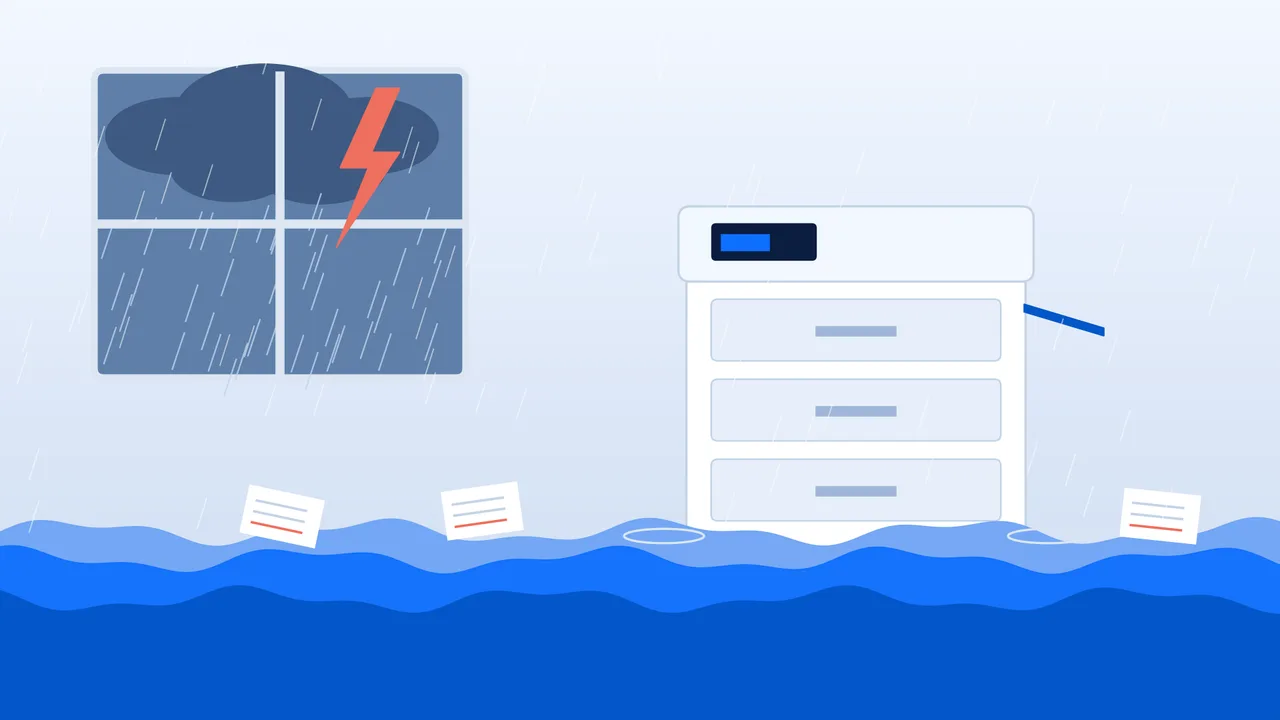
Hurricane flood waters wrecked two leased copiers on Long Island in 2012. A federal court still ordered the business to pay $258,424.39. Meet the hell-or-high-water clause, and the calls to make before the next storm.
Key takeaways
- Under a hell-or-high-water clause, copier lease payments keep coming even if the machine is flooded, burned or stolen. A business whose two leased copiers were destroyed by a hurricane was ordered to pay $258,424.39, plus attorneys' fees.[1][2]
- That's not a weird contract. The Uniform Commercial Code bakes it in: in a finance lease, risk of loss passes to you and your promises become "irrevocable and independent" once you accept the machine.[3][4]
- Disasters aren't rare. FEMA issued 58 major disaster declarations in 2026 through October 27, across 32 states and 2 territories. That's already more than all of 2025.[8]
- The fix is boring and it works: find the loss clause, get the formula in writing, insure the lessor's machine yourself, and never just stop paying.
The copier was underwater. The invoice was not.
In June 2011, a direct-marketing company on the south shore of Long Island signed a lease for two industrial copiers: 60 monthly payments of $6,229.30.[1] For over a year, nothing interesting happened. Then, in late October 2012, Hurricane Sandy hit, and the court later described the storm as "destroying nearly all of" the company's equipment, copiers included.[1]
The company did what most of us would do: it stopped paying for machines it could no longer use, after 19 of its 60 payments.[1]
The lessor repossessed both copiers and sold them through a remarketer, which pitched them to buyers who purchase that kind of equipment "for parts." Each one went for $2,200.[2] Then the lessor sued. The company argued that a hurricane nobody saw coming should excuse it. A federal court in Iowa said no, and in February 2014 entered judgment for the full amount requested: $258,424.39, plus attorneys' fees and costs.[1][2]
Our arithmetic on the court's numbers:
- Paid before the storm: 19 × $6,229.30 = $118,356.70.
- Judgment after the storm: $258,424.39, before attorneys' fees.[2]
- Together: $376,781.09. The entire 60-payment schedule was $373,758.00.
The judgment already credits the net resale proceeds.[2] So the business ended up owing $3,023.09 more than the whole lease would have cost if the storm had never come, before a single lawyer's bill.

The three sentences that did it
Because hell-or-high-water clauses are both ubiquitous and non-negotiable, presumptively enforcing these clauses creates a default rule that a commercial lessee bears the risk of an act of God.
Federal district judge, in a 2013 opinion footnote
The judge didn't have to get creative. The contract spelled it out:[1]
- Payment obligations were "absolute and unconditional and are not subject to cancellation, abatement, reduction, recoupment, defense or setoff for any reason whatsoever."
- "If any item of Equipment is lost, stolen or damaged ... Rental Payments will continue to accrue without abatement."
- The lessee was "responsible for loss and damage to the Equipment from any cause whatsoever on and after delivery."
Put those together and you get what lawyers call a hell-or-high-water clause: you pay "even if the thing leased is unsuitable, defective, or destroyed," as the court put it, quoting an Iowa Supreme Court decision.[1] The contract also required the company to insure the copiers "against all risks of physical loss or damage for its full replacement value," naming the lessor as loss payee.[1]
One twist: the lease had a $1 purchase option, so the court said it legally wasn't a lease at all but a secured transaction, basically a loan.[1] That didn't save the customer. The court said Iowa enforces these clauses "regardless of whether they are found in a lease or a secured transaction."[1] Here's how FMV and $1 deals differ, in our guide to types of copier lease contracts.
The footnote worth framing
In a footnote, the same judge wrote: "Because hell-or-high-water clauses are both ubiquitous and non-negotiable, presumptively enforcing these clauses creates a default rule that a commercial lessee bears the risk of an act of God."[1] He wrote that if he were deciding the question fresh, he "would not enforce" the clause against a valid act-of-God defense unless the parties had specifically bargained for it. He also quoted a 1999 business-law article: "The hell or high water clause is never negotiable."[1] He ruled against the customer anyway, quoting an earlier decision from the same court that these clauses "have been uniformly upheld by both state and federal courts, including the Iowa Supreme Court."[1]
We think the footnote is right. We also think the footnote doesn't pay your invoice.
It's not one bad contract. It's the law.
Blaming one lessor's fine print misses the point. The Uniform Commercial Code, the model law states build their commercial codes on, sets these rules for finance leases by default:
- Your promises lock in. In a finance lease that isn't a consumer lease, the lessee's promises "become irrevocable and independent upon the lessee's acceptance of the goods."[3]
- The risk moves to you. "In the case of a finance lease, risk of loss passes to the lessee."[4]
- Your complaints go to the supplier. In a finance lease, the supplier's promises and warranties extend to you.[5] A bad-machine complaint goes to whoever supplied it, not the company collecting payments.
A lawyer writing in an equipment-leasing trade association's magazine in 2025 called these clauses "part of the Ten Commandments of equipment finance," and noted that "courts generally have upheld" them.[6] In a 2019 decision on an equipment finance lease, a federal appeals court put it bluntly: the customer's only remedy was to seek new equipment, and "non-payment was not an option."[7]
Our copier leases are non-cancelable too. That's how this industry is financed, and we say so out loud.[11][12] The real question is whether you've planned for the day it matters.
The day it matters is not as rare as you think
We pulled FEMA's public data and counted major disaster declarations by year:[8]
- 2026 so far (through Oct. 27): 58 major disaster declarations, in 32 states and 2 territories. 21 of them were floods, hurricanes, tropical storms or typhoons.[8]
- All of 2025: 45.[8]
- 2024: 100.[8]
- 2015 through 2025: 693.[8]

A declaration doesn't mean your office flooded. But each one is a place where a leased copier may have sat in water while the lease kept billing.
What it would cost on our pricing
We publish our prices, so here's the math. Printree leases a full-size machine for $209–$349 a month, with 5,000 black-and-white and 500 color pages included, on terms up to 63 months.[11] If a machine on a 63-month lease were destroyed, here's what the remaining scheduled payments would add up to:
- After payment 12: 51 left = $10,659–$17,799.
- After payment 24: 39 left = $8,151–$13,611.
- After payment 36: 27 left = $5,643–$9,423.
- After payment 48: 15 left = $3,135–$5,235.
That's simple multiplication, not a quote, and real loss formulas vary. The Long Island contract, for example, set the loss amount as past-due payments plus the present value of future payments and the purchase-option amount.[1] Either way, early in a term a dead copier can still mean five figures.
What to do before the next storm
Before you sign (or today)
1. Find the clause. Search your lease for "absolute and unconditional," "without abatement," "any cause whatsoever," "risk of loss" and "casualty." If they're there, you're looking at a hell-or-high-water lease.
2. Get the loss formula in writing. Ask the lessor: "If this machine is destroyed in month 12, what exactly do I owe, and at what discount rate?" The Long Island contract offered two paths: repair or replace the machine, or pay the formula amount.[1]
3. Call your insurance agent, not your copier rep. Ask whether your business property policy covers equipment you lease but don't own, and whether the lessor can be named as loss payee. Ask about flood separately: the federal flood insurance program warns that "many business owners assume that general commercial insurance policies will cover flooding, but this is often not the case," and contents coverage has to be bought separately from building coverage.[9]
4. Compare that with the lessor's add-on. If your lease adds a loss damage waiver, our FAQ puts that charge at $15–$40 a month elsewhere in the industry.[11] We broke down what that copier lease insurance fee adds up to over a full term.
After the storm
5. If disaster hits, don't go silent. Photograph everything, file the insurance claim, and tell the lessor in writing right away. The Long Island company stopped paying and ended up with a judgment plus legal fees.[2] Stopping payments leads to collections and default judgments while the balance still stands.[11]
6. Ask the SBA about the payment itself. In a declared disaster area, SBA economic injury loans list "fixed debt payments" among allowed uses, and physical disaster loans cover damaged "machinery and equipment" not fully covered by insurance.[10] Ask whether you qualify.
Want out for other reasons? Here's how to get out of a copier lease without making it worse.
Sources
- U.S. District Court for the Northern District of Iowa, Memorandum Opinion and Order on Summary Judgment (Liability), No. C 13-59-MWB, 986 F. Supp. 2d 1029 (Dec. 3, 2013)
- U.S. District Court for the Northern District of Iowa, Memorandum Opinion and Order on Summary Judgment (Damages), No. C 13-59-MWB, 995 F. Supp. 2d 935 (Feb. 3, 2014)
- Uniform Commercial Code § 2A-407, Irrevocable Promises: Finance Leases (Legal Information Institute)
- Uniform Commercial Code § 2A-219, Risk of Loss (Legal Information Institute)
- Uniform Commercial Code § 2A-209, Lessee Under Finance Lease as Beneficiary of Supply Contract (Legal Information Institute)
- Hell or High Water—Maybe (October 2025)
- U.S. Court of Appeals for the Second Circuit, Summary Order, No. 18-3552-cv (Dec. 6, 2019)
- FEMA, OpenFEMA Dataset: Disaster Declarations Summaries - v2
- National Flood Insurance Program, Protecting Businesses with Flood Insurance (November 2024)
- U.S. Small Business Administration, Disaster Assistance
- Copier Leasing FAQ
- Types of Copier Lease Contracts
Frequently asked questions
What is a hell-or-high-water clause in a copier lease?
Language that makes your payments absolute and unconditional, so you keep paying even if the copier is defective, damaged or destroyed. For finance leases, the Uniform Commercial Code makes it the default once you accept the equipment.
Do I have to keep paying if my leased copier is destroyed in a flood or fire?
Under a hell-or-high-water clause, yes. A business whose two leased copiers were destroyed by Hurricane Sandy was ordered to pay $258,424.39 plus attorneys' fees. Check your contract with your attorney.
Who is responsible for insuring a leased copier?
Usually you. Finance leases put the risk of loss on the lessee and may require insurance naming the lessor as loss payee. Without proof of coverage, the lessor may add its own monthly charge.
Does business insurance cover flood damage to a leased copier?
Often not. The National Flood Insurance Program warns that general commercial policies often don't cover flooding. Ask your agent whether leased equipment is covered.
Can I negotiate a hell-or-high-water clause?
Rarely. A federal judge quoted a 1999 article calling it "never negotiable." You can still ask what you'd owe after a loss and whether your own insurance can replace the lessor's add-on.
Keep reading
More copier industry news

Can a Leased Copier Print Checks? MICR Toner Is the Easy Part
Can a leased copier print checks with MICR toner? What a bank-readable check really takes, and why check fraud makes the shared copier the wrong place.
The "Free" Copier Upgrade Is a Loan Wearing a Party Hat
Why a mid-lease "free" copier upgrade is an old balance in disguise, with the rollover math run on our own published prices.
The $126 Million Toner Call: Why Scammers Love Your Copier
One toner scheme took $126M from 50,000+ offices, many with toner already in their copier contracts. The script, the law on the bill, and the fix.